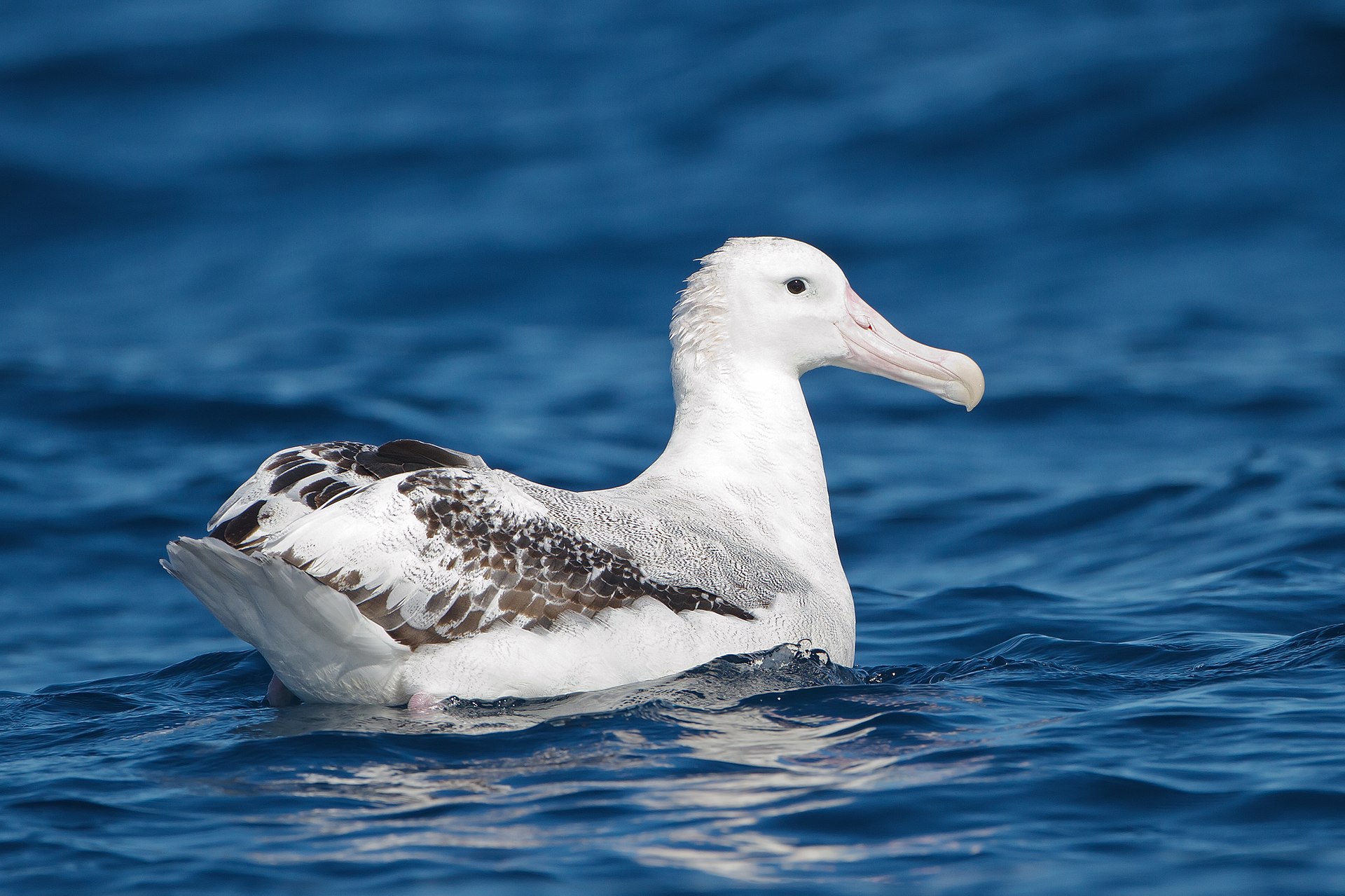
Photo: JJ Harrison (https://www.jjharrison.com.au/) · CC BY-SA 3.0 · License terms · Resized; framing may be cropped
Wandering Albatross (Diomedea exulans) is a member of the Diomedeidae family. It is found in Southern Ocean islands, where it inhabits southern ocean. Its feeding type is carnivore (squid and fish).
Last updated:
Quick stats
How it compares
Averages use recorded animals in the birds directory, not every animal in nature. Ranges use their midpoint; missing figures are excluded.
Length/Height
About 1.5 times longer than the directory group average.
49 recorded animals
Weight
About 1.2 times heavier than the directory group average.
50 recorded animals
Lifespan
About 3.1 times longer-lived than the directory group average.
11 recorded animals
Fast facts
- Scientific name
- Diomedea exulans
- Diet
- Carnivore (squid and fish)
- Habitat
- Southern Ocean
- Range
- Southern Ocean islands
- Social structure
- Colonies, mates for life
- Class
- Aves
- Order
- Procellariiformes
- Family
- Diomedeidae
Quick facts
- Has the longest wingspan of any living bird, over three metres.
- Adults typically weigh 6 to 12 kg.
- In the wild it can live 50 to 60 years.
- Its diet: carnivore (squid and fish).
- It belongs to the family Diomedeidae, in the order Procellariiformes.
Overview
The snowy albatross ( Diomedea exulans ), also known as the wandering albatross , white-winged albatross , or goonie , is a large seabird from the family Diomedeidae ; they have a circumpolar range in the Southern Ocean . It is the largest species of albatross and was long considered to be the same species as the Tristan albatross and the Antipodean albatross . Together with the Amsterdam albatross , it forms the wandering albatross species complex , which some began referring to more recently as "snowy".
The snowy albatross is one of the two largest members of the genus Diomedea (the great albatrosses ), being similar in size to the southern royal albatross . It has the greatest known wingspan of any living bird and is also one of the most far-ranging birds. Some individual snowy albatrosses are known to circumnavigate the Southern Ocean three times in one year, covering more than 120,000 km (75,000 mi) .
Appearance
The plumage varies with age, with the juveniles starting chocolate brown. As they age they become whiter. The adults have white bodies with white and black wings. Males have whiter wings than females, with just the tips and trailing edges of the wings black. The snowy albatross is the whitest of the wandering albatross species complex, the other species having a great deal more brown and black on the wings and body, very closely resembling immature wandering albatrosses. The large bill is pink, as are the feet. They also have a salt gland that is situated above the nasal passage and helps desalinate their bodies, due to the high amount of ocean water that they imbibe. They excrete a high saline solution from their nose, which is a probable cause for the pink-yellow stain seen on some animals' necks.
The snowy albatross has the longest wingspan of any living bird, reaching up to 3.7 m (12 ft) , with a mean span of 3.1 m (10 ft 2 in) in Bird Island, South Georgia . Wingspan measured an average of 3 m (9 ft 10 in) in 123 birds measured off the coast of Malabar, New South Wales . On the Crozet Islands , adults averaged 3.05 m (10 ft 0 in) in wingspan. The longest-winged specimens have been about 3.7 m (12 ft 2 in) . Two specimens have been reported having wingspans of 4.22 m (13 ft 10 in) and 5.3 m (17 ft 5 in) , but these reports remain unverified. As a result of its large wingspan, it is capable of remaining in the air without flapping its wings for several hours at a time (traveling 22m for every meter of drop). The length of the body is about 107 to 135 cm (3 ft 6 in to 4 ft 5 in) with females being slightly smaller than males.
Habitat and Range
The snowy albatross breeds on South Georgia Island , Crozet Islands , Kerguelen Islands , Prince Edward Islands , and Macquarie Island , is seen feeding year-round off the Kaikōura Peninsula on the east coast of the South Island of New Zealand , and ranges in all the southern oceans from 28° to 60°. Some individual snowy albatrosses are known to circumnavigate the Southern Ocean three times, covering more than 120,000 km (75,000 mi) , in one year. Snowy albatrosses spend most of their life in flight, landing only to breed and feed. Distances traveled each year are difficult to measure, but one banded bird was recorded traveling 6,000 km (3,700 mi) in twelve days.
Add your email for an amazing animal in your inbox once in a while.
Diet and Hunting
Snowy albatrosses travel vast distances to find food, and tend to feed further out in open oceans and in colder waters further south, whereas other albatross such as the related royal albatross tend to forage in somewhat shallower waters and closer to continental shelves. They feed at the surface, mainly during daylight hours, and are not well adapted for diving. During flight, speeds of 135 km/h (84 mph) have been recorded. They feed on cephalopods , small fish, and crustaceans . The species has been shown to be attracted to fishing vessels, foraging on bait, caught fish, and offal.
Reproduction and Young
The snowy albatross mates for life and breeds every other year. At breeding time they occupy loose colonies on isolated island groups in the Southern Ocean . When courting they will spread their wings, wave their heads, and rap their bills together while braying. Wanderers have a large range of displays from screams and whistles to grunts and bill clapping. They lay one egg that is white, with a few spots, and is about 10 cm (3.9 in) long. They lay between 10 December and 5 January. The nests are large bowls built of grassy vegetation and soil peat, that is 1 meter wide at the base and half a meter wide at the apex. Incubation takes about 11 weeks and both parents are involved. The 11-week incubation period is among the longest of any bird. During the early stages of the chick's development, the parents take turns sitting on the nest while the other searches for food. Later, both adults search for food and visit the chick at irregular intervals. Researchers previously assumed that chicks went without food for the whole winter after a weaning period of roughly 12 to 16 weeks. Later studies disproved this concept, as chicks were found to be feeding during this period. They are a monogamous species, usually for life. Adolescents return to the colony within six years; however, they will not start breeding until 11 to 15 years. About 31.5% of fledglings survive. They can live for over 50 years.
Conservation Status
The IUCN lists the snowy albatross as vulnerable status. Adult mortality is 5% to 7.8% per year as of 2003. It has an occurrence range of 64,700,000 km (25,000,000 sq mi) , although its breeding range is only 1,900 km (730 sq mi) .
The biggest threat to their survival is that they are attracted by the bait for longline fishing and get caught in the same way as the fish; however, pollution is also taking a toll, mainly from plastics and abandoned fishing hooks. The CCAMLR has introduced measures to reduce bycatch of albatrosses around South Georgia by 99%, and other regional fishing commissions are taking similar measures to reduce fatalities. The Prince Edward Islands are a nature preserve, the Macquarie Islands are a World Heritage site, and large parts of the Crozet Islands and the Kerguelen Islands are nature reserves.
Relationship with Humans
Sailors used to capture the birds for their long wing bones, from which they made tobacco pipe stems. The early explorers of the great Southern Sea were cheered by the companionship of the albatross in their dreary solitudes, and as shown in Coleridge 's The Rime of the Ancient Mariner killing them was seen as extremely bad luck. The metaphor of "an albatross around his neck" also comes from the poem and indicates an unwanted burden causing anxiety or hindrance. In the days of sail the bird often accompanied ships for days, not merely following a ship, but wheeling in wide circles around it without ever being observed to land on the water. The bird would continue its flight, apparently untired, in tempestuous as well as moderate weather.
The Māori of New Zealand used albatrosses as a food source. They caught them using baited hooks. Because the wing bones of albatross are light but very strong, Māori used them to make a number of different items including kōauau (flutes), needles, tattooing chisel blades, and barbs for fish hooks .
Article excerpts adapted from Wikipedia: Snowy albatross. Citation markers removed, punctuation normalized and excerpts shortened. Text is available under CC BY-SA 4.0. See the article history for contributors. The update date records this import, not an independent review of every claim.
Photo gallery
Watch
FAQ
What is the Wandering Albatross?
Wandering Albatross (Diomedea exulans) is a Diomedeidae animal in the order Procellariiformes.
Where does the Wandering Albatross live?
The Wandering Albatross is found in Southern Ocean islands. Its recorded habitat is southern ocean.
What does the Wandering Albatross eat?
The Wandering Albatross's recorded diet is carnivore (squid and fish). Food availability and feeding behavior vary across its range.
How does the Wandering Albatross live with other animals?
The Wandering Albatross's recorded social structure is colonies, mates for life. This can vary with age, season and local conditions.
What is the Wandering Albatross's conservation status?
The directory records the Wandering Albatross as Vulnerable. Check the linked IUCN assessment for the applicable taxon and assessment date.
Where can I read more about the Wandering Albatross?
Start with the linked species article, IUCN Red List and Animal Diversity Web resources. They provide references for the Wandering Albatross's identity, habitat and biology.
Featured in
Sources and further reading
More animals like this
 Critically Endangered
African Penguin
Weighs 2.2 to 3.5 kg
 Vulnerable
Atlantic Puffin
Top speed 88 km/h
 Birds
Adélie Penguin
Weighs 3.6 to 6 kg
 Vulnerable
Andean Condor
Weighs 8 to 15 kg
 Vulnerable
Atlantic Cod
Vulnerable
 Endangered
Banggai Cardinalfish
Endangered
 Endangered
Basking Shark
Endangered
 Endangered
Blue Whale
Top speed 50 km/h
 Birds
Brown Pelican
Least Concern
 Critically Endangered
California Condor
Weighs 7 to 14 kg
 Vulnerable
Common Seadragon
Vulnerable
 Vulnerable
Dugong
Weighs 230 to 500 kg