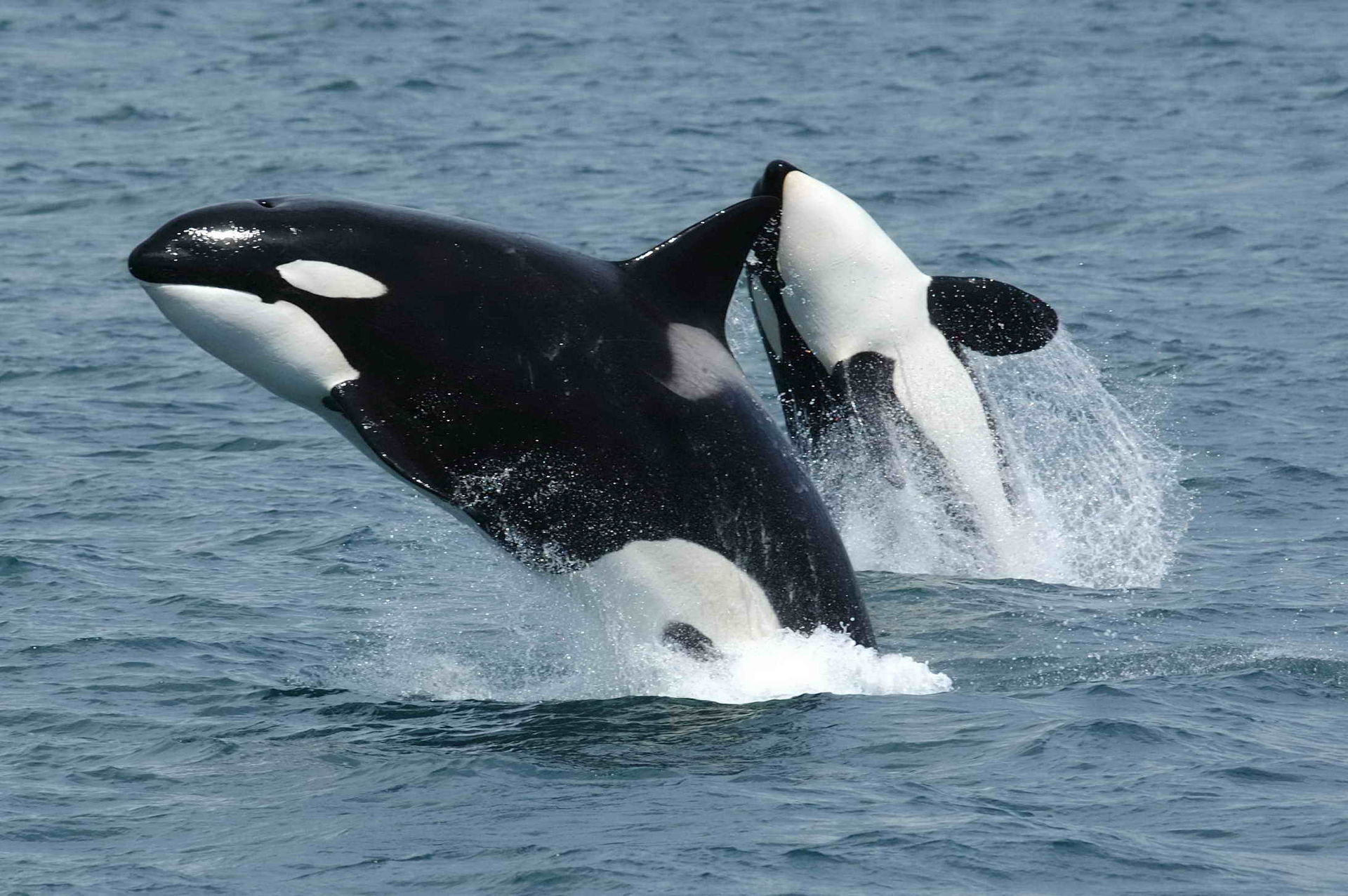
Photo: Robert Pittman · Public domain · Resized; framing may be cropped
Orca (Orcinus orca) is a member of the Delphinidae family. It is found in All oceans, where it inhabits coasts and open ocean. Its feeding type is carnivore.
Last updated:
Quick stats
How it compares
Averages use recorded animals in the ocean life directory, not every animal in nature. Ranges use their midpoint; missing figures are excluded.
Length/Height
About 2.2 times longer than the directory group average.
61 recorded animals
Weight
About 75% of the directory group average.
41 recorded animals
Top speed
About 1.3 times faster than the directory group average.
12 recorded animals
Lifespan
About 1.1 times longer-lived than the directory group average.
23 recorded animals
Fast facts
- Scientific name
- Orcinus orca
- Diet
- Carnivore
- Habitat
- Coasts and open ocean
- Range
- All oceans
- Social structure
- Matriarchal pods with their own dialects
- Class
- Mammalia
- Order
- Artiodactyla
- Family
- Delphinidae
Quick facts
- The largest dolphin, and every pod has its own hunting culture.
- At top speed it can reach about 56 km/h.
- Adults typically weigh 2 to 6 tonnes.
- In the wild it can live 30 to 90 years.
- Its diet: carnivore.
Overview
The orca ( Orcinus orca ), or killer whale , is a toothed whale and the largest member of the oceanic dolphin family. The only extant species in the genus Orcinus , it is recognizable by its distinct pigmentation, being mostly black on top, white on the bottom, and having recognizable white eye patches. A cosmopolitan species , it inhabits a wide range of marine environments, from Arctic to Antarctic regions to tropical seas, but is more commonly documented in temperate or cooler coastal waters. Scientists have proposed dividing the global population into races , subspecies , or possibly even species .
Orcas are apex predators with a diverse diet. Individual populations often specialize in particular types of prey, including bony fish , sharks , rays , and marine mammals such as seals , dolphins, and whales . They are highly social , with some populations forming stable matrilineal family groups (pods). Their sophisticated hunting techniques and vocal behaviours, often unique to specific groups and passed down from generation to generation, are considered to be manifestations of animal culture . The most studied populations are off the west coast of North America, which include fish-eating "residents", mammal-eating "transients", and offshores.
The International Union for Conservation of Nature (IUCN) lists the orca's conservation status as data deficient as multiple orca types may represent distinct species . Some local populations are threatened or endangered due to prey depletion, habitat loss , pollution (by PCBs ), captures for marine parks , and conflicts with fisheries . In late 2005, the southern resident orcas were added to the US Endangered Species list .
Habitat and Range
In the Antarctic, orcas range up to the edge of the pack ice and are believed to venture into the denser pack ice, finding open leads much like beluga whales in the Arctic. However, orcas are merely seasonal visitors to Arctic waters, and do not approach the pack ice in the summer. With the rapid Arctic sea ice decline in the Hudson Strait , their range now extends deep into the northwest Atlantic. Occasionally, orcas swim into freshwater rivers. They have been documented 100 mi (160 km) up the Columbia River in the United States. They have also been found in the Fraser River in Canada and the Horikawa River in Japan.
Orcas are found in all oceans and most seas. Due to their enormous range , numbers, and density, relative distribution is difficult to estimate, but they clearly prefer higher latitudes and coastal areas over pelagic environments. Areas which serve as major study sites for the species include the coasts of Iceland , Norway, the Valdés Peninsula of Argentina, the Crozet Islands , New Zealand and parts of the west coast of North America, from California to Alaska . Systematic surveys indicate the highest densities of orcas (>0.40 individuals per 100 km ) in the northeast Atlantic around the Norwegian coast, in the north Pacific along the Aleutian Islands , the Gulf of Alaska and in the Southern Ocean off much of the coast of Antarctica . They are considered "common" (0.20 to 0.40 individuals per 100 km ) in the eastern Pacific along the coasts of British Columbia , Washington and Oregon , in the North Atlantic Ocean around Iceland and the Faroe Islands .
Diet and Hunting
Orcas are apex predators , meaning that they themselves have no natural predators. They are sometimes called "wolves of the sea", because they hunt in groups like wolf packs. Orcas hunt varied prey including fish, cephalopods , mammals, seabirds , and sea turtles . Different populations or ecotypes may specialize, and some can have a dramatic impact on prey species. However, whales in tropical areas appear to have more generalized diets due to lower food productivity. Orcas spend most of their time at shallow depths, but occasionally dive several hundred metres depending on their prey. On average, an orca eats 227 kilograms (500 lb) each day.
Add your email for an amazing animal in your inbox once in a while.
Behavior and Social Life
Day-to-day orca behaviour generally consists of foraging , travelling, resting and socializing. Orcas frequently engage in surface behaviour such as breaching (jumping completely out of the water) and tail-slapping. These activities may have a variety of purposes, such as courtship, communication, dislodging parasites , or play . Spyhopping is a behaviour in which a whale holds its head above water to view its surroundings. They can also reach speeds of up to 15.5 m/s (56 km/h; 35 mph) . Resident orcas swim alongside porpoises and other dolphins .
Orcas will engage in surplus killing , that is, killing that is not designed to be for food. As an example, a BBC film crew witnessed orcas in British Columbia playing with a male Steller sea lion to exhaustion, but not eating it.
Orcas have complex societies. Only elephants and higher primates live in comparably complex social structures . Due to orcas' complex social bonds, many marine experts have concerns about how humane it is to keep them in captivity .
Closely related matrilines form loose aggregations called pods, usually consisting of one to four matrilines. Unlike matrilines, pods may separate for weeks or months at a time. DNA testing indicates resident males nearly always mate with females from other pods. Clans, the next level of resident social structure, are composed of pods with similar dialects, and common but older maternal heritage. Clan ranges overlap, mingling pods from different clans. The highest association layer is the community, which consists of pods that regularly associate with each other but share no maternal relations or dialects.
Reproduction and Young
Males mate with females from other pods, which prevents inbreeding . Gestation varies from 15 to 18 months. Mothers usually calve a single offspring about once every five years. In resident pods, births occur at any time of year, although winter is the most common. Mortality is extremely high during the first seven months of life, when 37 to 50% of all calves die. Weaning begins at about 12 months of age, and is complete by two years. According to observations in several regions, all male and female pod members participate in the care of the young.
Conservation Status
In 2008, the IUCN (International Union for Conservation of Nature) changed its assessment of the orca's conservation status from conservation dependent to data deficient , recognizing that one or more orca types may actually be separate, endangered species . Depletion of prey species , pollution , large-scale oil spills , and habitat disturbance caused by noise and conflicts with boats are the most significant worldwide threats. In January 2020, the first orca in England and Wales since 2001 was found dead with a large fragment of plastic in its stomach.
In the Pacific Northwest , wild salmon stocks, a main resident food source, have declined dramatically in recent years. In the Puget Sound region, only 75 whales remain with few births over the last few years. On the west coast of Alaska and the Aleutian Islands , seal and sea lion populations have also substantially declined.
Another conservation concern was made public in September 2008 when the Canadian government decided it was not necessary to enforce further protections (including the Species at Risk Act in place to protect endangered animals along with their habitats) for orcas aside from the laws already in place. In response to this decision, six environmental groups sued the federal government, claiming orcas were facing threats along the British Columbia Coast including increased boat traffic, water toxic wastes, and low salmon population, and the federal government did nothing to protect them.
Relationship with Humans
The Indigenous peoples of the Pacific Northwest Coast feature orcas throughout their art , history, spirituality and religion. The Haida regarded orcas as the most powerful animals in the ocean, and their mythology tells of orcas living in houses and towns under the sea. According to these stories, they took on human form when submerged, and humans who drowned went to live with them. For the Kwakwaka'wakw , the orca was regarded as the ruler of the undersea world, with sea lions for slaves and dolphins for warriors. In Nuu-chah-nulth and Kwakwaka'wakw mythology , orcas may embody the souls of deceased chiefs. The Tlingit of southeastern Alaska regarded the orca as custodian of the sea and a benefactor of humans. The Lummi consider orca to be people, referring to them as "qwe'lhol'mechen" which means "our relations under the waves".
Article excerpts adapted from Wikipedia: Orca. Citation markers removed, punctuation normalized and excerpts shortened. Text is available under CC BY-SA 4.0. See the article history for contributors. The update date records this import, not an independent review of every claim.
Photo gallery
Watch
FAQ
What is the Orca?
Orca (Orcinus orca) is a Delphinidae animal in the order Artiodactyla.
Where does the Orca live?
The Orca is found in All oceans. Its recorded habitat is coasts and open ocean.
What does the Orca eat?
The Orca's recorded diet is carnivore. Food availability and feeding behavior vary across its range.
How does the Orca live with other animals?
The Orca's recorded social structure is matriarchal pods with their own dialects. This can vary with age, season and local conditions.
What is the Orca's conservation status?
The directory records the Orca as Data Deficient. Check the linked IUCN assessment for the applicable taxon and assessment date.
Where can I read more about the Orca?
Start with the linked species article, IUCN Red List and Animal Diversity Web resources. They provide references for the Orca's identity, habitat and biology.
Featured in
Sources and further reading
More animals like this
 Ocean Life
Common Bottlenose Dolphin
Top speed 35 km/h
 Ocean Life
Beluga Whale
Weighs 700 to 1,600 kg
 Endangered
Blue Whale
Top speed 50 km/h
 Ocean Life
Humpback Whale
Weighs 25 to 40 tonnes
 Ocean Life
Narwhal
Weighs 800 to 1,600 kg
 Vulnerable
Sperm Whale
Weighs 15 to 45 tonnes
 Critically Endangered
Vaquita
Weighs 30 to 55 kg
 Ocean Life
California Sea Lion
Top speed 40 km/h
 Vulnerable
Dugong
Weighs 230 to 500 kg
 Ocean Life
Harbor Seal
Weighs 55 to 170 kg
 Ocean Life
Leopard Seal
Weighs 200 to 600 kg
 Vulnerable
Polar Bear
Top speed 40 km/h