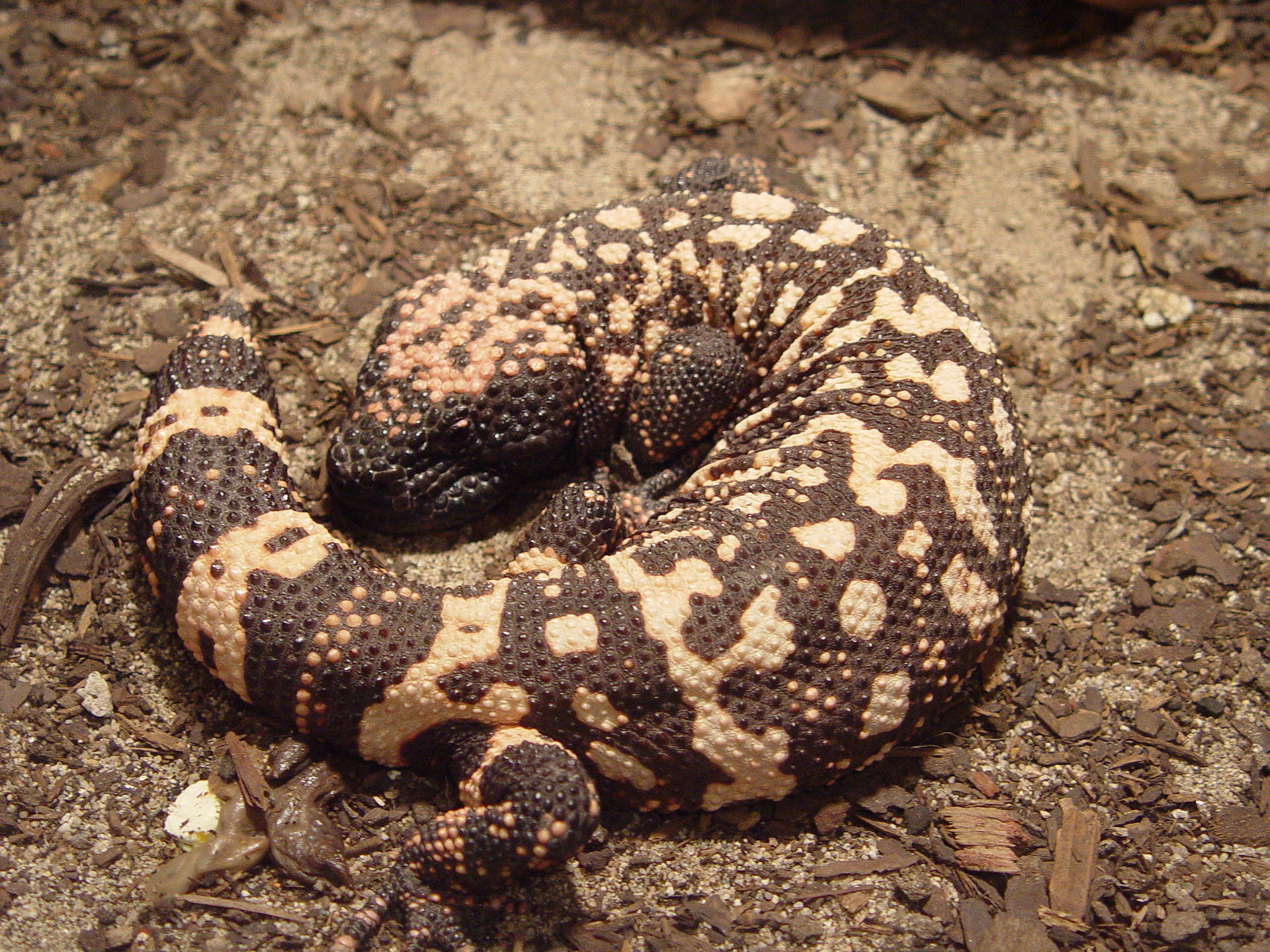
Photo: Blueag9 · CC BY-SA 3.0 · I, Blueag9 · License terms · Resized; framing may be cropped
Gila Monster (Heloderma suspectum) is a member of the Helodermatidae family. It is found in Southwestern United States, Northwestern Mexico, where it inhabits desert scrub. Its feeding type is carnivore (eggs and small animals).
Last updated:
Quick stats
How it compares
Averages use recorded animals in the reptiles directory, not every animal in nature. Ranges use their midpoint; missing figures are excluded.
Length/Height
About 22% of the directory group average.
29 recorded animals
Weight
About 1% of the directory group average.
17 recorded animals
Fast facts
- Scientific name
- Heloderma suspectum
- Diet
- Carnivore (eggs and small animals)
- Habitat
- Desert scrub
- Range
- Southwestern United States, Northwestern Mexico
- Social structure
- Solitary
- Class
- Reptilia
- Order
- Squamata
- Family
- Helodermatidae
Quick facts
- A venomous lizard whose saliva inspired a diabetes medicine.
- Adults typically weigh 1.35 to 2.3 kg.
- Its diet: carnivore (eggs and small animals).
- It belongs to the family Helodermatidae, in the order Squamata.
- Socially, it is solitary.
Overview
The Gila monster ( / ˈ h iː l ə / HEE -lə ; Heloderma suspectum ) is a species of venomous lizard native to the Southwestern United States and the northwestern Mexican state of Sonora . It is a heavy, slow-moving reptile, up to 22 in (56 cm) long, and it is the only venomous lizard native to the United States. The Gila monster is sluggish in nature, so it is not generally dangerous and very rarely poses a real threat to humans, though the bite is painful. Nonetheless, it has a fearsome reputation and is sometimes killed despite the species being protected by state law in Arizona .
The lower teeth have venom grooves to transmit the venom to the prey. The venom contains multiple peptides ; one of these, exendin-4, formed the basis for the development of the GLP-1 receptor agonists , used to treat type 2 diabetes and obesity .
Appearance
The Gila monster is the largest extant lizard species native to North America north of the Mexican border. Its snout-to-vent length ranges from 26 to 36 cm (10 to 14 in) . The tail is about 20% of the body size, and the largest specimens may reach 51 to 56 cm (20 to 22 in) in total length. Body mass is typically in the range of 550 to 800 g (1.21 to 1.76 lb) . They appear strong in their body structure with a stout snout, massive head, and "little"-appearing eyes, which can be protected by a nictitating membrane .
The Gila monster has four close living relatives, all of which are beaded lizards. There are three species in Mexico: Heloderma exasperatum , H. horridum and H. alvarezi , as well as another species in Guatemala: H. charlesbogerti .
The evolutionary history of the Helodermatidae may be traced back to the Cretaceous period (145 to 166 million years ago), when Gobiderma pulchrum and Estesia mongolensis were present. The genus Heloderma has existed since the Miocene , when H. texana lived. Fragments of osteoderms from the Gila monster have been found in Late Pleistocene (10,000 to 8,000 years ago) deposits near Las Vegas, Nevada . Because the helodermatids have remained relatively unchanged morphologically, they are occasionally regarded as living fossils . Although the Gila monster appears closely related to the monitor lizards (varanids) of Africa, Asia, and Australia, their wide geographical separation and distinct features indicate that Heloderma is better placed in a separate family.
Habitat and Range
The Gila monster is found in the Southwestern United States and Mexico, across a range including Sonora, Arizona, and parts of California , Nevada , Utah , and New Mexico. No records have been given from Baja California . They inhabit scrubland , succulent desert, and oak woodland, seeking shelter in burrows, thickets, and under rocks in locations with a favorable microclimate and adequate humidity. Gila monsters rely heavily on the use of shelters and spend much of their time dwelling there. Often times these shelters are in rocky areas in Navajo Sandstone and basaltic lava flows. Gila monsters depend on water resources and can be observed in puddles of water after a summer rain. They avoid living in open areas, such as flats and open grasslands.
Add your email for an amazing animal in your inbox once in a while.
Diet and Hunting
The Gila monster's diet consists of a wide range of small animals to mammals (such as young rabbits , hares , mice , ground squirrels , and other rodents ), small birds , snakes , lizards, frogs , insects , other invertebrates , carrion , and the eggs of birds, lizards, snakes, and tortoises . Three to four extensive meals in spring are claimed to give Gila monsters enough energy for a whole season. They can store fat in their tails and therefore do not need to eat often. Nevertheless, they feed whenever they come across suitable prey. Young Gila monsters can swallow up to half of their body weight in a single meal. Adults may eat up to one third of their body weight in one meal.
The Gila monster uses its extremely acute sense of smell to locate prey. The strong, two-ended tipped tongue, which is pigmented in black-blue colors, picks up scent, enabling the animal to hunt by day or night.
Prey may be crushed to death if large, or eaten alive, most of the time head first, and helped down by muscular contractions and neck flexing. After food has been swallowed, the Gila monster may immediately resume tongue flicking and search behavior in order to identify further prey such as eggs or young in nests. Gila monsters are able to climb trees, cacti , and even fairly straight, rough-surfaced walls.
Behavior and Social Life
Among adaptations to a dry environment is a slow metabolism, allowing them to use less than half the amount of energy expected for lizards of their size. Gila monsters, and possibly also the Mexican beaded lizard , store water in their urinary bladder and reabsorb it across the bladder epithelium. Their tail is used for energy storage in the form of fat.
Reproduction and Young
Gila monsters emerge from brumation in early March. They become sexually mature at 4 to 5 years old. Mating takes place in April and May. The male initiates courtship by flicking his tongue to search for the female's scent. If the female rejects his advances, she will bite him and chase him away. When successful, copulation has been observed in captivity to last from 15 minutes to two and a half hours. There is only a single record of attempted mating outside of a shelter. The female lays eggs at the end of May into June. A clutch may consist of up to eight (rarely more than six) eggs. Hatching occurs near the end of October and immediately proceeds into hibernation without surfacing. Hatchlings are some 6.5 inches (17 cm) long and weigh around 0.075 pounds (34 g) .
In summer, Gila monsters gradually spend less time on the surface to avoid the hottest part of the season; occasionally, they may be active at night. Females that have laid eggs are exhausted and thin, fighting for survival, and have to spend extra effort to "reconstitute". The brumation of Gila monsters begins in October.
In 1963, the San Diego Zoo became the first zoo to successfully breed Gila monsters in captivity. In the last two decades, experienced breeders have shared their knowledge and expertise to give advice to other herpetologists on overcoming the difficulties in Heloderma reproduction under human care.
Conservation Status
Gila monsters are listed as near threatened by the IUCN . They are listed as "Apparently Secure" by NatureServe .
Relationship with Humans
The constituents of H. suspectum venom that have received the most attention from researchers are the bioactive peptides, including helodermin, helospectin, exendin-3, and exendin-4. Exendin-4, which is specific for H. suspectum , has formed the basis of a class of medications for the treatment of type 2 diabetes and obesity / metabolic syndrome , known as the GLP-1 receptor agonists .
The Gila monster has also seen usage as a mascot and state symbol . The official mascot of Eastern Arizona College located in Thatcher, Arizona , is Gila Hank, a gun-toting, cowboy hat-wearing Gila monster. In 2017, the Vegas Golden Knights selected a Gila monster named Chance as their official mascot. In 2019, the state of Utah made the Gila monster its official state reptile .
Though the Gila monster is venomous, it poses little threat to humans due to its sluggish nature. Nevertheless, it has a fearsome reputation and is often killed by humans. Myths that have formed about the Gila monster include that the animal's breath is toxic enough to kill humans, that it can spit venom like a spitting cobra , that it can leap several feet in the air to attack, and that it did not have an anus and therefore expelled waste from its mouth, the source of its venom and "fetid breath".
In 2023, Australian band King Gizzard and the Lizard Wizard released a single titled " Gila Monster " from their album PetroDragonic Apocalypse , with the album's artwork featuring a Gila monster on its cover art and heavily within the album's concept narrative.
Article excerpts adapted from Wikipedia: Gila monster. Citation markers removed, punctuation normalized and excerpts shortened. Text is available under CC BY-SA 4.0. See the article history for contributors. The update date records this import, not an independent review of every claim.
Photo gallery
Watch
FAQ
What is the Gila Monster?
Gila Monster (Heloderma suspectum) is a Helodermatidae animal in the order Squamata.
Where does the Gila Monster live?
The Gila Monster is found in Southwestern United States, Northwestern Mexico. Its recorded habitat is desert scrub.
What does the Gila Monster eat?
The Gila Monster's recorded diet is carnivore (eggs and small animals). Food availability and feeding behavior vary across its range.
How does the Gila Monster live with other animals?
The Gila Monster's recorded social structure is solitary. This can vary with age, season and local conditions.
What is the Gila Monster's conservation status?
The directory records the Gila Monster as Near Threatened. Check the linked IUCN assessment for the applicable taxon and assessment date.
Where can I read more about the Gila Monster?
Start with the linked species article, IUCN Red List and Animal Diversity Web resources. They provide references for the Gila Monster's identity, habitat and biology.
Sources and further reading
More animals like this
 Reptiles
Argentine Black and White Tegu
Least Concern
 Near Threatened
Ball Python
Near Threatened
 Reptiles
Black Mamba
Size 2 to 3 m
 Endangered
Blue Iguana
Endangered
 Reptiles
Boa Constrictor
Weighs 10 to 27 kg
 Vulnerable
Burmese Python
Size 3.7 to 5.7 m
 Reptiles
Common Basilisk
Size 70 to 80 cm
 Reptiles
Common Leopard Gecko
Weighs 45 to 80 g
 Reptiles
Corn Snake
Least Concern
 Vulnerable
Crested Gecko
Vulnerable
 Reptiles
Eastern Diamondback Rattlesnake
Size 0.84 to 2.4 m
 Reptiles
Emerald Tree Monitor
Least Concern