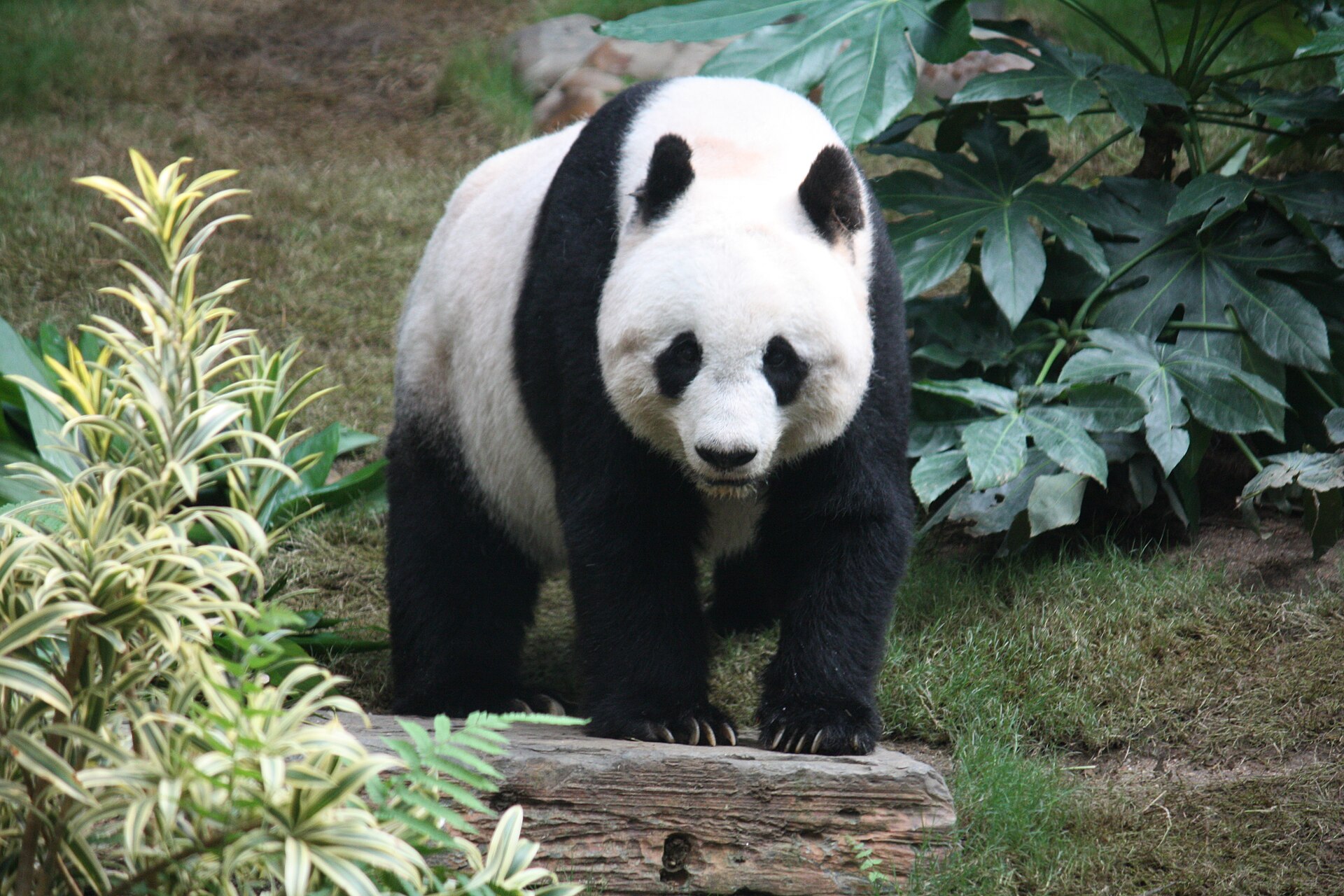
Photo: J. Patrick Fischer · CC BY-SA 3.0 · License terms · Resized; framing may be cropped
Giant Panda (Ailuropoda melanoleuca) is a member of the Ursidae family. It is found in Central China, where it inhabits mountain bamboo forest. Its feeding type is herbivore (bamboo).
Last updated:
Quick stats
How it compares
Averages use recorded animals in the bears directory, not every animal in nature. Ranges use their midpoint; missing figures are excluded.
Length/Height
About 85% of the directory group average.
10 recorded animals
Weight
About 47% of the directory group average.
10 recorded animals
Lifespan
About 82% of the directory group average.
9 recorded animals
Fast facts
- Scientific name
- Ailuropoda melanoleuca
- Diet
- Herbivore (bamboo)
- Habitat
- Mountain bamboo forest
- Range
- Central China
- Social structure
- Solitary
- Class
- Mammalia
- Order
- Carnivora
- Family
- Ursidae
Quick facts
- Spends up to 14 hours a day eating bamboo.
- Adults typically weigh 70 to 125 kg.
- In the wild it can live 15 to 20 years.
- Its diet: herbivore (bamboo).
- It belongs to the family Ursidae, in the order Carnivora.
Overview
The giant panda ( Ailuropoda melanoleuca ), also known as the panda bear or simply panda , is a bear species endemic to China . It is characterised by its white coat with black patches around the eyes, ears, legs and shoulders. Its body is rotund; adult individuals weigh 100 to 115 kg (220 to 254 lb) and are typically 1.2 to 1.9 m (3 ft 11 in to 6 ft 3 in) long. It is sexually dimorphic , with males being typically 10 to 20% larger than females. A thumb is visible on its forepaw, which helps in holding bamboo in place for feeding. It has large molar teeth and expanded temporal fossae to meet its dietary requirements. It can digest starch and is mostly herbivorous with a diet consisting almost entirely of bamboo and bamboo shoots .
The giant panda lives exclusively in six montane regions in a few Chinese provinces at elevations of up to 3,000 m (9,800 ft) . It is solitary and gathers only in mating seasons. It relies on olfactory communication and uses scent marks as chemical cues and on landmarks like rocks or trees. Females rear cubs for an average of 18 to 24 months. The oldest known giant panda was 38 years old.
Appearance
The giant panda has a body shape typical of bears. It has black fur on its ears, limbs, shoulders and around the eyes. The rest of the animal's coat is white. The giant panda's distinctive coloration appears to serve as camouflage in both winter and summer environments as they do not hibernate . The white areas serve as camouflage in snow, while the black shoulders and legs conceal them in shade. Studies in the wild have found that when viewed from a distance, the panda displays disruptive coloration , while up close, they rely more on blending in . The black ears may be used to display aggression, while the eye patches might facilitate them identifying one another. The giant panda's thick, woolly coat keeps it warm in the cool forests of its habitat.
The giant panda's paw has a digit similar to a thumb and five fingers ; the thumb-like digit is actually a modified sesamoid bone that helps it to hold bamboo while eating. The evolution of the panda's pseudo-thumb may have occurred because the first digit of its forepaws, equivalent to the thumb in primates, is not opposable and is aligned with the rest of the digits. The giant panda's tail, measuring 10 to 15 cm (3.9 to 5.9 in) , is the second-longest in the bear family after the sloth bear .
Habitat and Range
The giant panda is endemic to China . It is found in small, fragmented populations in six mountainous regions in the country, mainly in Sichuan , and also in neighbouring Shaanxi and Gansu . Successful habitat preservation has seen a rise in panda numbers, though loss of habitat due to human activities remains its biggest threat. In areas with a high concentration of medium-to-large-sized mammals , such as domestic cattle , a species known to degrade the landscape , the giant panda population is generally low. This is mainly attributed to the panda's avoidance of interspecific competition .
The species has been located at elevations of 2,400 to 3,000 m (7,900 to 9,800 ft) above sea level. They frequent habitats with a healthy concentration of bamboos, typically old-growth forests , but may also venture into secondary forest habitats. The Daxiangling Mountain population inhabits both coniferous and broadleaf forests. Additionally, the Qinling population often selects evergreen broadleaf and conifer forests, while pandas in the Qionglai mountainous region exclusively select upland conifer forests. The remaining two populations, namely those occurring in the Liangshan and Xiaoxiangling mountains, predominantly occur in broadleaf evergreen and conifer forests.
Add your email for an amazing animal in your inbox once in a while.
Diet and Hunting
During the shoot season from April to August, the giant panda stores a large amount of food in preparation for the months succeeding this seasonal period, in which it lives off a diet of bamboo leaves. The average giant panda eats 9 to 14 kg (20 to 31 lb) of bamboo shoots per day to compensate for the limited energy content of its diet. Ingestion of such a large quantity of material is possible and necessary because of the rapid passage of large amounts of indigestible plant material through the short, straight digestive tract. Such rapid passage of digesta limits the potential of microbial digestion in the gastrointestinal tract, limiting alternative forms of digestion. Given this voluminous diet, the giant panda defecates up to 40 times a day.
The limited energy input imposed on it by its diet has affected the giant panda's behaviour. It tends to limit its social interactions and avoids steeply sloping terrain to limit its energy expenditures. Their field metabolic rate, the amount of energy used by an animal in its daily life, is one of the lowest reported among mammals, comparable to that of sloths.
The bamboo eater giant panda and the insectivorous sloth bear have resting or basal metabolic rates that are 18% and 41% lower, respectively, than predicted for a placental mammal of their same body mass, whereas the omnivorous American black bear and the carnivorous polar bear have basal metabolic rates that are 23% and 62%, respectively, higher than predicted for their body masses.
Giant pandas will travel between different habitats if they need to, so they can get the nutrients that they need and to balance their diet for reproduction.
Behavior and Social Life
Pandas communicate through vocalisation and scent marking such as clawing trees or spraying urine . They are able to climb and take shelter in hollow trees or rock crevices, but do not establish permanent dens. For this reason, pandas do not hibernate , which is similar to other subtropical mammals, and will instead move to elevations with warmer temperatures. Pandas rely primarily on spatial memory rather than visual memory . Though the panda is often assumed to be docile, it has been known to attack humans on rare occasions. Pandas have been known to cover themselves in horse manure to protect themselves against cold temperatures.
The species communicates foremost through a blatting sound; they achieve peaceful interactions through the emission of this sound. When in oestrus, a female emits a chirp. In hostile confrontations or during fights, the giant panda emits vocalizations such as a roar or growl. On the other hand, squeals typically indicate inferiority and submission in a dispute. Other vocalizations include honks and moans.
Reproduction and Young
Initially, the primary method of breeding giant pandas in captivity was by artificial insemination , as they seemed to lose their interest in mating once they were captured. This led some scientists to trying methods such as showing them videos of giant pandas mating and giving the males sildenafil (commonly known as Viagra). In the 2000s, researchers started having success with captive breeding programs, and they have now determined giant pandas have comparable breeding to some populations of the American black bear , a thriving bear species.
Attempts have also been made to reproduce giant pandas by interspecific pregnancy where cloned panda embryos were implanted into the uterus of an animal of another species. This has resulted in panda fetuses, but no live births.
Conservation Status
The giant panda is a vulnerable species , threatened by continued habitat destruction and habitat fragmentation , and by a very low birthrate, both in the wild and in captivity . Its range is confined to a small portion on the western edge of its historical range, which stretched through southern and eastern China, northern Myanmar , and northern Vietnam . The giant panda is scattered into more than 30 subpopulations of relatively few individuals. The building of roads and settlements near giant panda habitats causes declines in population. Diseases from domesticated pets and livestock is another threat. It is estimated that by 2100, the giant panda's range will shrink by up to 100%, mainly due to the effects of climate change .
Relationship with Humans
In the 2020s, certain "celebrity pandas" have gained a cult following amongst internet users, with dedicated fan accounts existing to keep tabs on the animals. Known as "giant panda fever" or "panda-monium", individual giant pandas get billions of views and engagements on social media, as well as product lines specifically emulating them. At Chengdu Research Base of Giant Panda Breeding , certain of these "celebrity pandas" garner hours-long lines specifically to see them.
Article excerpts adapted from Wikipedia: Giant panda. Citation markers removed, punctuation normalized and excerpts shortened. Text is available under CC BY-SA 4.0. See the article history for contributors. The update date records this import, not an independent review of every claim.
Photo gallery
Watch
FAQ
What is the Giant Panda?
Giant Panda (Ailuropoda melanoleuca) is a Ursidae animal in the order Carnivora.
Where does the Giant Panda live?
The Giant Panda is found in Central China. Its recorded habitat is mountain bamboo forest.
What does the Giant Panda eat?
The Giant Panda's recorded diet is herbivore (bamboo). Food availability and feeding behavior vary across its range.
How does the Giant Panda live with other animals?
The Giant Panda's recorded social structure is solitary. This can vary with age, season and local conditions.
What is the Giant Panda's conservation status?
The directory records the Giant Panda as Vulnerable. Check the linked IUCN assessment for the applicable taxon and assessment date.
Where can I read more about the Giant Panda?
Start with the linked species article, IUCN Red List and Animal Diversity Web resources. They provide references for the Giant Panda's identity, habitat and biology.
Sources and further reading
More animals like this
 Vulnerable
Asian Black Bear
Weighs 50 to 200 kg
 Vulnerable
Polar Bear
Top speed 40 km/h
 Vulnerable
Sloth Bear
Weighs 55 to 145 kg
 Vulnerable
Spectacled Bear
Weighs 60 to 175 kg
 Vulnerable
Sun Bear
Weighs 25 to 80 kg
 Bears
American Black Bear
Top speed 48 km/h
 Bears
Brown Bear
Top speed 56 km/h
 Bears
Grizzly Bear
Top speed 56 km/h
- Bears
Kodiak Bear
Weighs 180 to 680 kg
 Endangered
African Wild Dog
Top speed 66 km/h
 Critically Endangered
Amur Leopard
Weighs 25 to 48 kg
 Endangered
Bengal Tiger
Top speed 65 km/h