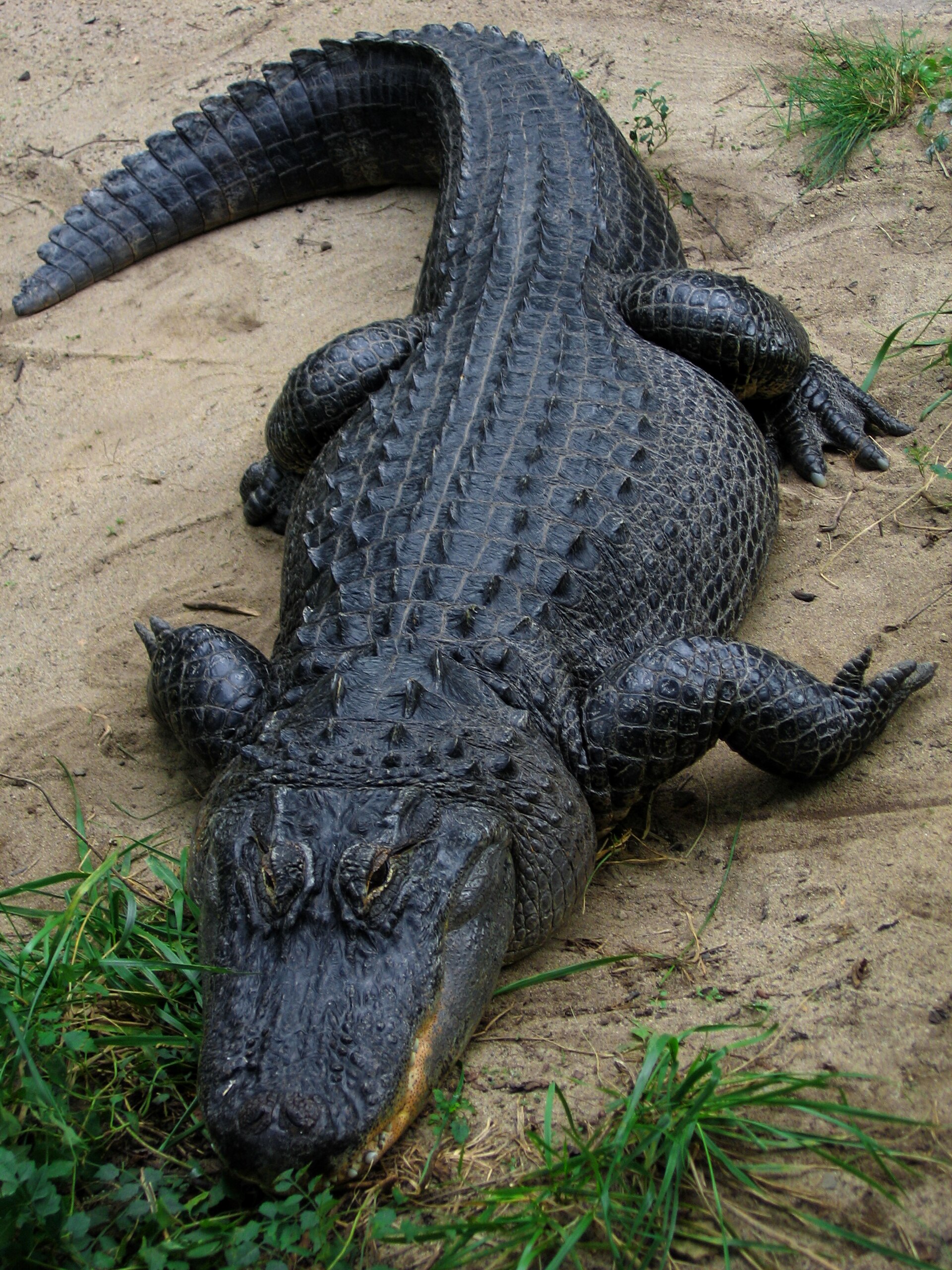
Photo: User:Postdlf · CC BY-SA 3.0 · Postdlf · License terms · Resized; framing may be cropped
American Alligator (Alligator mississippiensis) is a member of the Alligatoridae family. It is found in Southeastern United States, where it inhabits freshwater swamps, rivers and lakes. Its feeding type is carnivore.
Last updated:
Quick stats
How it compares
Averages use recorded animals in the reptiles directory, not every animal in nature. Ranges use their midpoint; missing figures are excluded.
Length/Height
About 1.7 times longer than the directory group average.
29 recorded animals
Weight
About 1.5 times heavier than the directory group average.
17 recorded animals
Lifespan
About 70% of the directory group average.
9 recorded animals
Fast facts
- Scientific name
- Alligator mississippiensis
- Diet
- Carnivore
- Habitat
- Freshwater swamps, rivers and lakes
- Range
- Southeastern United States
- Social structure
- Solitary
- Class
- Reptilia
- Order
- Crocodilia
- Family
- Alligatoridae
Quick facts
- Brought back from near extinction, it now numbers in the millions.
- Adults typically weigh 90 to 450 kg.
- In the wild it can live 35 to 50 years.
- Its diet: carnivore.
- It belongs to the family Alligatoridae, in the order Crocodilia.
Overview
The American alligator ( Alligator mississippiensis ), sometimes referred to as a common alligator or just gator , is a large crocodilian reptile native to the Southeastern United States . It is one of the two extant species in the genus Alligator , and is larger than the only other living alligator species, the Chinese alligator .
The conservation status of the American alligator is listed as Least Concern by the International Union for Conservation of Nature . Historically, hunting had decimated their population, and the American alligator was listed as an endangered species by the Endangered Species Act of 1973 . Subsequent conservation efforts have allowed their numbers to increase and the species was removed from endangered status in 1987. The species is the official state reptile of three states: Florida , Louisiana , and Mississippi .
Appearance
The American alligator is a relatively large species of crocodilian . On average, it is the largest species in the family Alligatoridae , with only the black caiman being possibly larger. Weight varies considerably depending on length, age, health, season, and available food sources. Similar to many other reptiles that range expansively into temperate zones, American alligators from the northern end of their range, such as southern Arkansas , Alabama , and northern North Carolina , tend to reach smaller sizes. Large adult American alligators tend to be relatively robust and bulky compared to other similar-length crocodilians; for example, captive males measuring 3 to 4 m (9 ft 10 in to 13 ft 1 in) were found to weigh 200 to 350 kg (440 to 770 lb) , although captive specimens may outweigh wild specimens due to lack of hunting behavior and other stressors.
Large male American alligators reach an expected maximum size up to 4.6 m (15 ft 1 in) in length and weigh up to 900 kg (2,000 lb) , while females reach an expected maximum of 3 m (9 ft 10 in) . However, the largest free-ranging female had a total length of 3.35 m (11 ft 0 in) and weighed 147 kg (324 lb) . On rare occasions, a large, old male may grow to an even greater length.
Habitat and Range
In 2021, an individual was found in Calvert County , Maryland , near the Chesapeake Bay , where it was shot and killed by a hunter using a crossbow . Additional reports of American alligators from this region exist, though they are believed to be escaped or released exotic pets.
In some areas of their range, American alligators are an unusual example of urban wildlife ; golf courses are often favored by the species due to an abundance of water and a frequent supply of prey animals such as fish and birds.
Recent research on juvenile American alligators has found that young alligators can adjust behavior in reaction to stressful environments, particularly with higher salt levels. Rather than adapting physically, juveniles have been shown to change their everyday habits to things like basking in the sun or moving between habitats to to avoid dehydration from salt water .
Add your email for an amazing animal in your inbox once in a while.
Diet and Hunting
Additionally, American alligators engage in what seems to be cooperative hunting. One observation of cooperative hunting techniques was where there are pushing American alligators and catching American alligators and they were observed taking turns in each position. Another observation said that about 60 American alligators gathered in an area and would form a semicircle with about half of them and would push the fish closer to the bank. Once one of the American alligators caught a fish another one would enter into its spot, and it would take the fish to the resting area. This was reported to have occurred two days in a row.
Reproduction and Young
The breeding season begins in the spring. On spring nights, American alligators gather in large numbers for group courtship, in the aforementioned "water dances". A study conducted in the 1980s at an alligator farm showed that homosexual courtship is common, with two-thirds of the recorded instances of sexual behaviour having been between two males. Multiple paternity is thought to occur. The female builds a nest of vegetation, sticks, leaves, and mud in a sheltered spot in or near the water.
The young are tiny replicas of adults, with a series of yellow bands around their bodies that serve as camouflage. Hatchlings gather into pods and are guarded by their mother and keep in contact with her through their "yelping" vocalizations. Young American alligators eat small fish, frogs, crayfish, and insects. They are preyed on by large fish, birds, raccoons, Florida panthers, and adult American alligators. Mother American alligators eventually become more aggressive towards their young, which encourages them to disperse. Young American alligators grow 3 to 8 in (7.6 to 20.3 cm) a year and reach adulthood at 6 ft (1.8 m) .
Lifespan
American alligators typically live to the age of 50, and possibly over 70 years old. Males reach sexual maturity at around 11.6 years, and females at around 15.8 years. Although it was originally thought that American alligators never stop growing, studies have now found that males stop growing at around the age of 43 years, and females stop growing at around the age of 31 years.
Conservation Status
American alligators are listed as least concern by the IUCN Red List , even though from the 19th century to the mid-20th century, they were being hunted and poached by humans unsustainably.
Historically, hunting and habitat loss have severely affected American alligator populations throughout their range, and whether the species would survive was in doubt. In 1967, the American alligator was listed as an endangered species (under a law that was the precursor to the Endangered Species Act of 1973), since it was believed to be in danger of extinction throughout all or a significant portion of its range. Some states began protecting the species on their own initiative well before the federal listing; Alabama banned alligator hunting in 1938, becoming the first state to do so, nearly three decades ahead of federal protection.
Both the United States Fish and Wildlife Service (USFWS) and state wildlife agencies in the South contributed to the American alligator's recovery. Protection under the Endangered Species Act allowed the species to recuperate in many areas where it had been depleted. States began monitoring their American alligator populations to ensure that they would continue to grow. In 1987, the USFWS removed the animal from the endangered species list, as it was considered to be fully recovered. The USFWS still regulates the legal trade in American alligators and their products to protect still endangered crocodilians that may be passed off as American alligators during trafficking.
American alligators are listed under Appendix II of the Convention on International Trade in Endangered Species (CITES) meaning that international trade in the species (including parts and derivatives) is regulated.
Relationship with Humans
American alligators are capable of killing humans, but fatal attacks are rare. Mistaken identity leading to an attack is always possible, especially in or near cloudy waters. American alligators are often less aggressive towards humans than some crocodile species, which are larger and of which some species (mainly the Nile and saltwater crocodiles) may prey on humans with some regularity. Alligator bites are serious injuries, due to the reptile's sheer bite force and risk of infection. Even with medical treatment, an American alligator bite may still result in a fatal infection.
The Gator Bowl is a college football game held in Jacksonville annually since 1946, with Gator Bowl Stadium hosting the event until the 1993 edition. The Gatornationals is a NHRA drag race held at the Gainesville Raceway in Gainesville since 1970.
"Gators" has been the nickname of the University of Florida 's sports teams since 1911. In 1908, a printer made a spur-of-the-moment decision to print an alligator emblem on a shipment of the school's football pennants. The mascot stuck, and was made official in 1911, perhaps because the team captain's nickname was Gator. Allegheny College and San Francisco State University both have Gators as their mascots, as well.
Article excerpts adapted from Wikipedia: American alligator. Citation markers removed, punctuation normalized and excerpts shortened. Text is available under CC BY-SA 4.0. See the article history for contributors. The update date records this import, not an independent review of every claim.
Photo gallery
Watch
FAQ
What is the American Alligator?
American Alligator (Alligator mississippiensis) is a Alligatoridae animal in the order Crocodilia.
Where does the American Alligator live?
The American Alligator is found in Southeastern United States. Its recorded habitat is freshwater swamps, rivers and lakes.
What does the American Alligator eat?
The American Alligator's recorded diet is carnivore. Food availability and feeding behavior vary across its range.
How does the American Alligator live with other animals?
The American Alligator's recorded social structure is solitary. This can vary with age, season and local conditions.
What is the American Alligator's conservation status?
The directory records the American Alligator as Least Concern. Check the linked IUCN assessment for the applicable taxon and assessment date.
Where can I read more about the American Alligator?
Start with the linked species article, IUCN Red List and Animal Diversity Web resources. They provide references for the American Alligator's identity, habitat and biology.
Featured in
Sources and further reading
More animals like this
 Critically Endangered
Chinese Alligator
Size 1.5 to 2.1 m
 Vulnerable
American Crocodile
Vulnerable
 Critically Endangered
Gharial
Weighs 160 to 250 kg
 Reptiles
Nile Crocodile
Weighs 225 to 750 kg
 Reptiles
Saltwater Crocodile
Weighs 400 to 1,000 kg
 Endangered
African Spurred Tortoise
Endangered
 Vulnerable
Aldabra Giant Tortoise
Weighs 150 to 250 kg
 Endangered
Alligator Snapping Turtle
Endangered
 Reptiles
Amazon Mata Mata
Least Concern
 Reptiles
Argentine Black and White Tegu
Least Concern
 Near Threatened
Ball Python
Near Threatened
 Reptiles
Black Mamba
Size 2 to 3 m